Summary
The Lemko people inhabited the mountain areas on the north and south slopes of the Carpathian Mts. or, more exactly, the Lower and partly Western Beskidy Mts. In the past the Lemko area was divided by two the Polish-Hungarian - and actually by three - Polish, Czechoslovak and USSR -political frontiers. Interest in these people dates back to the 1830's. It was found that the name 'Lemko, Lemkowie' appeared for the first time in 1834 in a Russian language grammar
1. Studies of the eventually individuated ethnographic Lemko group, its culture, origin and range of appearance have been most advanced in Polish science 2. The provenance of this group is, however, still not uniformly determined by sciences of relevant ethnic groups and neighboring countries (in the past, particularly by Austria. Germany and Russia). Two opinions predominate. Fast Slavonic researchers think that the Lemko people descended from original Russian settlers in this area while Polish scientists, on the basis of interdisciplinary studies, link their genesis with the so-called Wolosk colonization comprising multi-ethnic, nomadic Balkan shepherds 3, who came to these areas from the 14th to the mid-17th centuries and mixed with earlier Polish and later with less numerous German settlers 4. This view has also been accepted by Czech. Slovak and some Ukrainian researchers.Since the beginning the Lemko people were linked with the Eastern (Orthodox) Church and those on Polish areas, at least since the Union of Brzes'c' (1596) with the Uniate-Greek-Catholic-Church. On areas south of the Carpathians they accepted the Church Union in the 17th century (1648). The Lemkos built their houses of God from wood up to the end of the 18th century. The appearance of stone-or-brick churches in this area was linked with 'Josephinism' - a reformation action of the Catholic Church initiated by the Court in Vienna.
The Polish Lemko area, enclosed by the rivers Poprad in the West and Oslawa in the East, embraced about 170 villages stretching in a straight line about 140 kilometers long and 20-30 kilometers wide. Following World War II, due to activities of Ukrainian nationalists in the eastern part of this area up to 1947, most of the Lemko people were resettled to the western or northern territories of the Polish State or to the USSR. In turn, the Slovak Lemko area lies approximately between the river Poprad in the West and the present-day Czechoslovak-Russian border in the East. But the boundaries of the Lemko area have been exactly defined in Slovakia as they were in Poland and the entire population of Russian (Ukrainian) origin was identified with the Lemko people (locally known as Lemaki). The appearance of Lemko communities in Carpathian Ruthenia remains, in the light of ethnographic studies. an open question. In the region of Mukachevo there remained, however, sacral buildings from the second half of the 18th century, characteristic of the Polish-Slovak Lemko area. Once. there must have been in this area either an enclave or a wedge of Lemko people linked with their settlements in Slovakia. communities which with the passing of time lost their ethnographic characteristics. The appearance in the 18th century of Lemko churches in Carpathian Ruthenia could also be explained by a temporal 'fashion' or a transfer of styles.
The Lemko orthodox churches have been mentioned rather early in literature on the subject5, but the name of the ethnographic group was linked with the relevant group of orthodox churches for the first time probably in Florian Zapletal's article in 1924 7. The notion of wooden orthodox churches of the Lemko people was introduced to European scientific literature by Vladimir Roman Zaloziecki in 19266 . Further popular-scientific articles published in the inter-war period fixed the still prevailing belief that typical characteristics of a Lemko orthodox church were: a tripartite construction with a wider and higher nave. a tent-shaped roof topped with spherical (onion-shaped) turret finials and a room tower in the west with a dome shaped as those on the finials. Researchers directed attention early at these typical constructions. verging on a duplication of a scheme. and this image, though not quite correct, prevailed until our times.
Requirements of Eastern liturgy and tradition developed in the cultural circle of pre-Partition Poland (it looked slightly different in Balkan cultural circles and in the Duchy of Moscow) a conception of a tripartite longitudinal arrangement of wooden sacral buildings comprising three basic sections. These three church sections were not equal although they were built on similar, quadrilateral projections resembling squares. The nave was usually the largest and highest room while the presbytery and women's porch were smaller and lower usually of similar dimensions. Thus, two factors: centralness and symmetry. accented in the projection and mass of the sacral building played a decisive role in the cultural circle referred to in the shaping of the spatial plan and the composition of the wooden church mass. But there was an additional element in Lemko orthodox churches which influenced a part obliteration of the legibility of the central-symmetric system: this element. decisive in the style of a Lemko orthodox church. was the tower. integrally linked in the west with the church into one body and usually 'shifted on' the church porch. In the silhouette of Lemko churches this tower played a high dominance, just as in many Latin churches. But in Lemko churches the presbytery and nave were covered with tent-like, angled cupolas seen also in the mass as mansard roofs, topped, moreover, with spherical, apparent ave-bell turrets. Characteristic of the Lemko church mass was, therefore. its gradual rising of particular segments from east to west, from the presbytery to the tower. this rising of particular segments provided orthodox churches of this type with much charm and picturesqueness.
The charm of Lemko churches lies not only in the picturesqueness of their mass but results from the very substance of the wood material, from moss-grown timbering and shingles covering the roofs, cupolas, roofing. eaves and walls of the church. This picturesqueness is increased by the harmonious relationship with the landscape. one could say. the buildings merge with the surrounding landscape. Wooden Lemko churches dispersed through mountain valleys are usually situated close to rivers and creeks, on their banks. or on small near by hills or slopes of larger rises. They were always surrounded by a circle of trees out of which domes and ave-bell turrets emerged representing, together with the thicket an impressive landscape image. The closest environment of the church - i.e., churchyards - were encircled by wooden framework fences constructed from logs covered by one- or two-faced shingle roofs or made from stones often also covered with shingle roofs. Wood gates - even if there was no fence - led to the churchyard where there were often many stone, wood or iron crosses. Wrought iron crosses crowned the gates, tower domes, apparent turrets, porches and free-standing bell towers. There was an amazing variety of forms and a wonderful ornamentation not repeated even within one church. Each of the crosses had its individual, particular form although ornamental elements were repeated.
Returning to the spatial arrangement and the mass of Lemko orthodox churches we found that they were not so schematic as former researchers assumed. A more detailed analysis of relic material (preserved or known from iconographic sources) allows to make a working separation of types and their variants, differing between each other by essential architectonic solutions and at the same time allow to better understand the history of these wooden churches.
1. The North- Western Type appears in the weste rn and central Lemko area on the Polish side of the Carpathian Mts. and in the c lose neighborhood of the Polish border on the Slovak side. It is characterized b y a tripartite projection with particular segments resembling squares of which the nave is always the widest (a bipartite projection appears though rarely on the Slovak side), a differentiated height of particular sections with the nave framework always the highest; a tower with rooms (or apparent rooms) with slanting walls embracing from the west a part of or the entire women's porch, with or without a gallery encircling the tower and the eastern part of the porch, tent-like offset slanting roofs-cupolas with analogous or almost the same spaces between particular bends; tower domes, nave and presbytery finials with apparent lanterns almost always shaped analogous over all basic sections of the. church. Orthodox churches of these forms which include the oldest examples (Powroznik, Owczary, Bodruzal, Kwiaton, Petna, Ladomirova, Tylicz) can be recognized as classic 'pure style' examples of Lemko churches and defined as the older variant of this type. The later variant is characterized by a tendency to longer naves protruding porches (linked with the growing number of parishioners); an irregularity of spaces between roof offsets cupolas or their complete disappearance, sometimes replaced by cornice bends; a more frequent use of a trilateral closure of presbyteriums (it appeared sometimes also in buildings of the older variety but only on the Polish side); the common appearance of vestries erected together with the entire building. The oldest churches of this type originated in the last quarter of the 18th century (Krasne, Savis'sky, Stiavnik, Chyrowa, Czertyzhne, Krajna Bystra, Piorunka, Hunkovce), the latest were built just after the mid-19th century (Dubne, Leluchow, Kunkowa). Some earlier built churches (e.g., Brunary Wyzhne, Mokhnachka Nizhna).
2. The Southern Type appears only on the Slovak side of the Carpathian Mts. Its characteristics are:
the appearance besides the 'traditional' tripartite projection of a bipartite arrangement - the presbytery is square, the nave elongated with an inside individuated woman's porch;
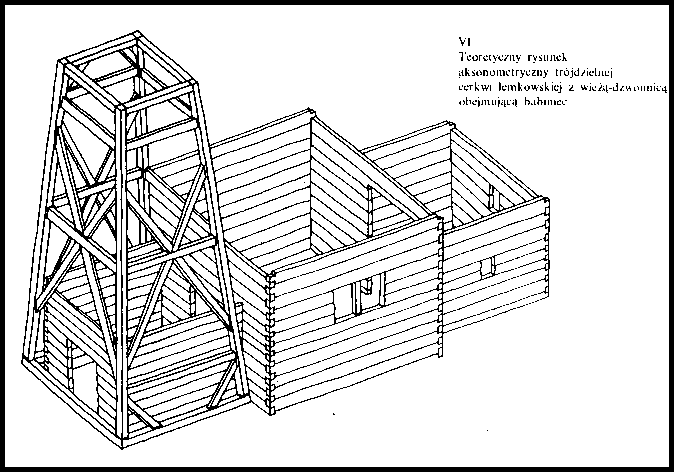
Theoretical isometric sketch
of a tri-partite Lemko tserkva
with bell-tower
enclosing the women's porch (babinets).
towers are without rooms (an exception is Vyzhny Hrabovec) or have apparent rooms with straight walls placed on the framework of the western part of the nave; some presbyteries (Korejovce) have framework ceilings with bed-molding in place of bend cupolas; tent-like domes of towers and finials finished with onion-shaped capitals (exception: Semetkovce). Known examples of this type originated in the 18th century and include the orthodox church at Lipowiec (probably built in 1703), being the only example from the northern slopes of the Polish Carpathian Mts.
3. The South-Eastern Type appears in the western area of Carpathian Ruthenia and is characterized by a bipartite projection (sporadically a tripartite projection - Svaljava - with a trilaterally closed presbytery). a room tower with arcades (Svaljava, Szelestovo) or an apparent room (Velke Loucki, Hlinanec, Obava), with straight walls set on the framework of the externally situated women's porch; with cupola roofs with many bends often without offsets, with spherical finials analogous to those of the north-western type:
pillared arcades surrounding the 'tower part' the roofs of which extend over presbyteries supported there by protruding framework beams. Six of known relics of this type are linked with the 18th century.
4. The North-Eastern Type appears in the eastern Lemko area on the Polish side of the Carpathian Mts. It was codified in 1969 8. After latter additions, its characteristics have been defined as follows: a horizontal, essentially tripartite projection, elongated, this elongation is considerably increased by the addition of a lengthwise axis of a vestibule of an equal width as the women's porch (sometimes externally separated in the women's porch). and sometimes also of a vestry in an extension of the presbytery. the bight of the framework of all three basic parts of the church is the same, the presbytery, nave and women's porch (sometimes only the presbytery and nave) are covered by octagonal cupolas, hidden under a common single-ridge roof, the cupolas are gradually replaced by ceilings and the single-ridge roof is bent into three separate parts corresponding to the basic rooms of the church. the ridge under the nave is the highest set part. The basic part of the church is crowned by spherical, magnificent apparent ave-bell turrets, the inside of the church is encircled by two identical cornices beneath the eaves and above the windows. In the towerless variant there is, at a distance from the church on its longitudinal axis. an imposing free standing bell tower of a pillar-framework construction (sometimes brick-work) which also fulfills the function of a gate; in the tower variant the low pillar-framework tower is situated above the western part of the women's porch section.
The oldest recognized example of the towerless variant was the not preserved church at Zubetisk (1789), and the tower variant: the orthodox church at Moszczaniec (1834).
5. The Northern-Decadent Type, associated with the western and central Lemko area on the northern side of the Carpathian Mts., is characterized by: tri- and bi-partite projections (in the latter plan the nave is elongated with an externally separated women's porch) and the presbytery usually closed trilaterally; room (or apparent room) turrets; the height of the framework of particular parts of the church is not always differentiated (e.g., orthodox churches at Krolowa Gorna, Ropica Gorna, have the same framework height I: a two-slope roof with differentiated ridges; the roof over the presbytery is always lower (only the church at Krolowa Gorna has a single-ridge roof); interiors covered with a flat ceiling sometimes with a bed-molding.
The oldest known relics originated in the last 15 years of the 18th century (Zdynia, Nova Wies) and the most recent appeared at the end of the 1850's and 1860's (Bogusha, Regietow Vyzhny). In the second half of the last century older relics, modernized in those times, received a similar setting (Przyslow, Banica).
An arrangement of particular orthodox churches into the above discussed types allows to reach certain conclusions: 1. through the 18th century there existed on Polish and Slovak Carpathian slopes stylistic pure Lemko orthodox churches in a mature and developed form (of the north-western type in the older variant, the south and south-eastern type); 2. preserved earlier examples prove that thus shaped churches existed also throughout the 17th century; 3. the decline of the 'classic' mass of Lemko orthodox churches occurred in the fourth quarter of the 18th century; 4. on Polish northern slopes of the Carpathian Mts. where the Lemko tradition was strong the 'classical' Lemko orthodox church prevailed up to the mid-19th century but in a reduced form (the later variant of the north-western type); 5. at the turn of the 18th and 19th centuries there developed in Polish Lemko areas further two derivative types:
the northern-decadent (characteristic of western and central areas) and the north-eastern (characteristic of the entire eastern area, gradually adopting in those times Lemko characteristics). The genesis of these two types was connected with the introduction of official Austrian patterns for brick-built sacral buildings (they were their local interpretation in wood); 6. the final period of the 'Lemko style' in sacral architecture occurred after the mid-19th century, while orthodox churches built later would be of an epigonal type (Zlockie, Czyrna) or would relate to former tradition (Krynica, Slotwiny, Wawrzka). In those times there also appeared buildings typical of other areas or orthodox church architecture (Krzywa) or attempts at introducing the then developing Ukrainian national style (Kamianna, Gladyszow).
The genesis of Lemko orthodox churches (similar to geneses of other regional types of former wooden church architecture) has not been explained so far, although Wlodzimierz Siczynski made a decisive statement on this problem already in l9279. This researcher said that Lemko churches do not represent an individual type of sacral buildings but their original form (without tower) was the Boyko style (although he used both terms in his works). The same view was represented later by R. Brykowski (1968), R. Reinfuss (1969), St. Michalczuk, Cz. Kielbon (1970). In the light of present day researches this view does not seem to be uniform and the problem of the genesis should be examined from two aspects, namely the projection and mass integrally linked with the tower. Analyzing horizontal projections we found the appearance of tripartite arrangements (characteristic of the Polish cultural circle) on the northern slopes and of tri- and two-partite arrangements (the last characteristic of the Balkan cultural circle) on the southern slopes of the Carpathian Mts. Analyzing towers from the aspect of construction, we determined two types: towers with slanting walls set on the ground (characteristic of Polish areas, the oldest examples of this type are known from the seal of Torun', 1300) and towers with vertical walls set on frameworks (characteristic of the Balkan circle). It follows that two obviously different cultural circles were responsible for the shaping of Lemko orthodox churches. Other differences in the shaping of the two types of church architecture are perceptible differences in the general proportions of buildings and the absence of surrounding roofing supported by protruding ceiling beams in Lemko orthodox churches.
Franciszek Strzalko, stating that the Boyko orthodox churches are much younger in their basic mass than Lemko churches, wrote: "if certain forms spread over a large area in an insular manner are older forms. Boyko orthodox churches with their towering tops occupy a relatively small and compact territory contrary to Lemko churches, they are, therefore, a later form than the Lemko buildings" 10 .
We can, therefore, accept a suggestion - contrary to W. Siczynski - that it was not the Lemko churches which derived from the Boyko form but the Boyko form derived from Lemko churches.
An essential problem in our deliberations on the genesis of Lemko churches is the question whether the bell-tower was linked with Lemko churches since the beginning i.e.. whether it existed with 17th century buildings or was joined to 18th century churches, exactly in the fourth quarter of the 18th century? Unfortunately. out of the oldest known orthodox churches (including Powroz'nik, Owczary, Bodruzhal, Kwiaton', Petna) only the bell-tower at Kwiaton has been dated to 1743. This is the oldest certain date of a bell-tower integrally linked with Lemko churches (but it could be the restoration date or an earlier built tower). A new link which may confirm the earlier existence of Lemko type tower churches in the Carpathian Mts. seem to be iconographic records from the end of the 15th century up to the turn of the 16th-17th centuries. A presentation of a building most closely resembling the classical' Lemko orthodox church is to be seen in the icon of St. Paraskevia in the National Museum, Cracow.
One of the most essential problems linked with Lemko churches is the so called 'Latinization of the orthodox church style' with its stylistic element: the room-bell-tower taken over from sub-Carpathian church architecture on the Polish side of the Carpathian Mts. Assuming that the tower church is characteristic of the Balkans we can speak only of the adoption of local elements such as the external dress (room) and construction solutions (set on the ground). The 'Latinization' itself relating to towers - should be seen in the Latinization of Balkan orthodox churches in the mature Gothic period. And thus, Latinization in Lemko areas was expressed. above all, in the interior equipment of orthodox churches - pulpits. organs (ranging from the 18th century to the first half of the 19th century). and in architecture: the introduction of two-slope roofs, vestries and a trilateral closing of presbyteries (from the end of the 18th century).
Only few names of founders and carpenter-builders are known from Lemko settlement areas. They were socially and nationally differentiated. Founders included noblemen (Duke Karol Radziwill, Voivode of Vilna), representatives of the gentry, priests and common folk. Noblemen and the gentry were usually donors who financed the building of churches, the clergy and communities were generally the initiators of buildings and provided (communities) the labor force.
Carpenter-builders gave the churches their final shape but probably not without the advice and participation of the "(uniat) rector and the commune". Few names are known and even of those men we know only that they built a concrete object - nothing else. The ethnic and social origin of men cannot be determined with certainty on the basis of well known names. The few names available and analogies to neighboring areas make us believe that some builders were local men, others were traveling craftsmen who came various social and ethnical groups. Analyses of orthodox churches as regards their construction indicate that builders included professional carpenters, semi-professionals and folk carpenters.
Detailed studies of particular Lemko orthodox churches carried out on the occasion of conservation works in the second half of the 1960's have shown that the exterior of these buildings was painted in the past 11.
A reflection of the old vividness and picturesqueness of the old churches has remained on the shingles and planks as faded, rain-washed larger or smaller patches which have lost their old intensity. Exterior painting covered cornices, arcade framing, timbering or shingles of walls and shingled areas of roofs. tower and turret domes. Until recently painting appeared on many Lemko orthodox churches but it was destroyed lately either with the building itself or during restoration works, through lack of knowledge. when previous timbering or shingles were removed entirely or the woodwork was impregnated with chemicals. At the same time, we do not know whether the painting of some churches at present tightly covered with tin sheets - has still remained under this cover on shingles or cornices. The largest painted patches were found on orthodox churches at Swiatkowa Wielka, Swiatkowa Mala and Bartne. Dark-blue-red-green colors dominated at Swiatkowa Wielka, dark-blue pink, light-green and sky-blue colors at Swiatkowa Mala. But a real orgy of colors was once at Bartne, where there were. side-by-side, dark and light blue, white, red, ochre, dark and light brown, dark (emerald) and light green colors. The first and so far the only attempt at reconstructing exterior painting was made at restoration works at Bartne (1968-1970).
Exterior painting of Lemko churches was found in the entire Polish, Slovak and Carpathian area of Lemko settlement. Apart from the multicolor 'non-image' painting of larger or smaller surfaces. image painting relics have also been preserved. They include arcade friezes in the orthodox church at Andrzejowka and Brunary Wyzhne and once colorful flower bouquets on areas of the arcade frieze in the Czarna Gorlica church.
It was not determined at what time orthodox churches were originally painted. Painting appeared not only on shingles and timbering - elements which after some time have to be exchanged - but also on permanent architectonic elements such as 18th century cornices, but this is no proof that these churches were painted already in those times. The only certain dates are: 1891 in the church at Ropki and 1901 in the Uniat chapel at Gladyszow. The first known description of preparing coloring matter for coating house walls in the eastern Lemko area (Koman'cza and Lupkow areas) comes from 1877. This practice must have been known, therefore, for some time and probably was used not only for painting houses. The problem of dating exterior painting of Lemko churches will probably be explained by further field and archival researches. We may accept at present only that, apart from the 19th century, also the last years of the 18th century were the period when this painting was applied.
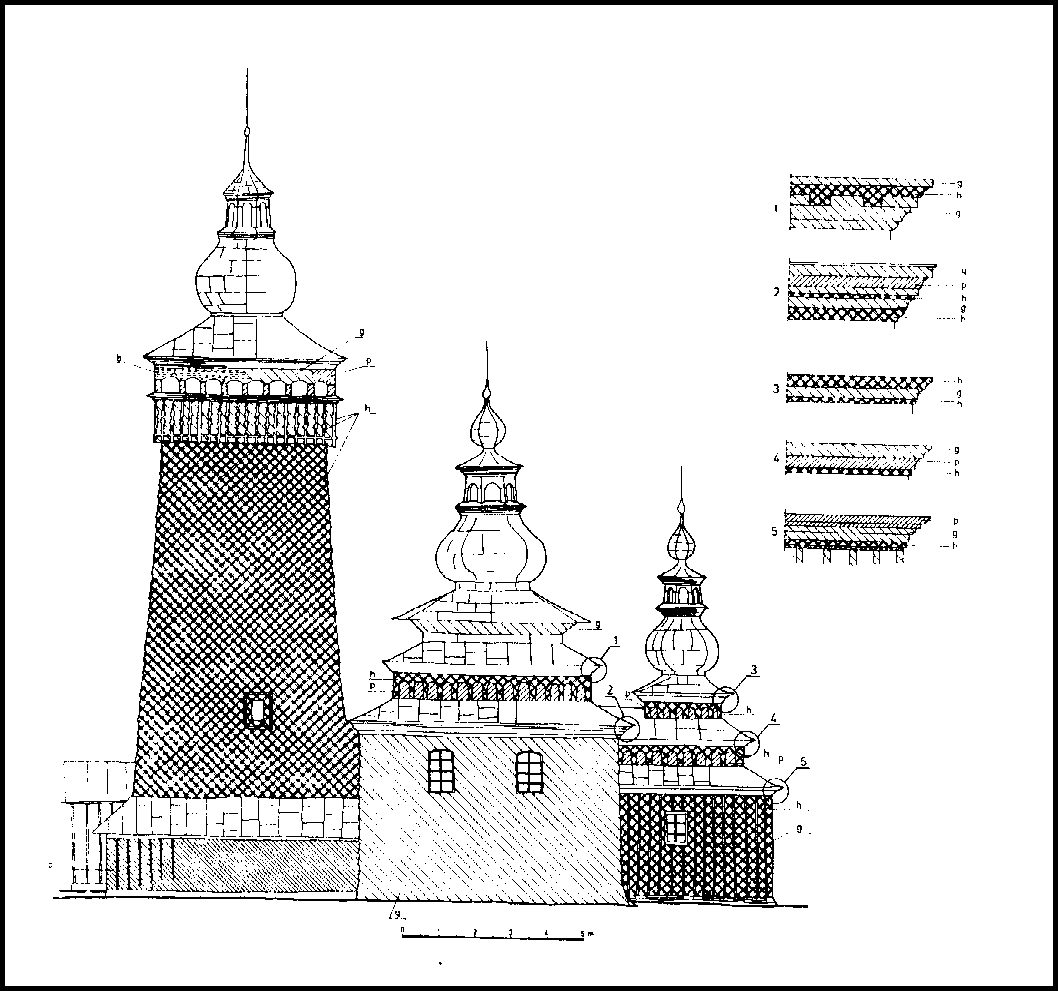
Swiatkowa Wielka - Greek-Catholic Tserkva - 1757
inventory of exterior paint
with bell-tower
b - ugier (Pol.)
g - ultramarine
h - various shades of green
o - brown
p - scarlet vermillion
Analyzing the preserved or only known relic 'painting' material no regularities have been found in the appearance of particular color arrangements. The succession of applied colors seems to have been chosen at will, depending only on the 'aesthetic taste' of the painter. In the orthodox church at Swiatkowa Wielka, apart from the dark-blue-red arrangement referred to, the cornices are also painted in other combinations, e.g., red-dark blue-green, or green-dark blue-green. Observations made so far allow us to assume that these three colors and also white were the most readily and generally used. While the multi-colored cornices in the Bartne church seems to have resulted from several successive re-paintings and of colors showing through.
The purpose of painting wooden Lemko churches was probably not aesthetic but, above all. practical. linked with the protection and conservation of the building material, just like it was done previously in many regions by smearing the wood with crude oil and, in more modern times. by spraying or saturating in chemicals.
The presented history of wooden Lemko orthodox churches, based on present day knowledge. seem to clearly indicate the background against which this architecture emerged and developed and its history during the mature and final period (18th-20th centuries). The beginnings and the shaping of this type
of orthodox church architecture are still not completely known but iconographic sources already referred to suggest the possibility of existence of 'Lemko style' churches already at the turn of the 15th-16th centuries.
The author is aware that this outline is not free of mistakes and corrections may be added as new facts emerge.
Translated by Jan Rudzki
2. R. Reinfuss, Lemkowie jako grupa etnograficzna, "Prace i Materialy Etnograliczne". 7:1948, s. 77-210.
3. K. Dobrowolski, Migracje woloskie na ziemiach polskich. Pamietnik V Zjazdu Historykow Polskich, I, Lvow 1930;- Ibid. Elementy rumunsko-balkanskie w kulturze ludowej Karpat Polskich [w;] Drugi Zjazd sprawozdawczo-naukowy poswiecony srodkowym I wschodnim Karpatom Polskim w Krakowie dnia 30 i 31 pazdziernika 1938 roku, Warsaw 1938.
4 M. Dobrowolska, Z badan' nad osadnictwem Lemkowszczyzny [w:] Drugi Zjazd..., op. cit.
5 K. Moklowski, Sztuka Ludowa w Polsce Lvov 1903.
6 F.Zapletal, Lemkovsky typ rusinskeho chramu, Ceskoslovenska Republika. Praha 1924.
7 W. R. Zaloziecky, Gotische und Barocke Holzkirchen in den Karpathenlandern. Wien 1926.
8 S.Michalczuk, Cerkiew w Komanczy, woj. rzeszowskie, pow. sanocki. Dokumentacja naukowo-historyczna. Lublin. maszynopis w Oddziale Pracowni Konseracji Zabytkow.
9 W. Sichynskyj, Bojkiwskij typ drewnianych cerkwi w Karpatach, Lwow 1927; Ibid, Drevene stavby v Kapatske oblasti, Praha 1940.
10 F. Strzalko, Korespondencja (list z dn. 10 VI 1982 w posiadaniu autora).
11 R. Brykowski. Malowane cerkwie."Ochrona Zabytkow". 32:1979, nr 3. s. 228-38.
Local Links:
 Return to Lemko Home Page
Document Information Document URL: http://lemko.org/lih/rbrykowski.html
Page prepared by Walter Maksimovich
E-mail: walter@lemko.org
Copyright © LV Productions, Ltd.
E-mail: webmaster@lemko.org
Originally Composed: April 8th, 1996
Date last modified: September 20th, 2002